


Score single substitutions with PoET-2
In this tutorial you will score the single-substitution variants of one protein sequence with PoET-2, then read the results as a table and a heatmap and narrow them with a filter. Unlike in workflows where you apply a custom trained property predictor model, in this tutorial we will be using PoET-2’s capability to score variants zero-shot from sequence context, so no trained model or experimental dataset is needed. In the zero-shot case, PoET-2 scores sequences for evolutionary likelihood, where higher likelihood corresponds with biologically relevant properties that would have been selected for in the course of evolution, including thermostability, solubility, expressability and more.
Before starting
- An OpenProtein.AI project.
- The input sequence to analyze. This tutorial uses the TEM-1 wild-type sequence:
MSIQHFRVALIPFFAAFCLPVFAHPETLVKVKDAEDQLGARVGYIELDLNSGKILESFRPEERFPMMSTFKVLLCGAVLSRVDAGQEQLGRRIHYSQNDLVEYSPVTEKHLTDGMTVRELCSAAITMSDNTAANLLLTTIGGPKELTAFLHNMGDHVTRLDRWEPELNEAIPNDERDTTMPAAMATTLRKLLTGELLTLASRQQLIDWMEADKVAGPLLRSALPAGWFIADKSGAGERGSRGIIAALGPDGKPSRIVVIYTTGSQATMDERNRQIAEIGASLIKHW- A prompt for PoET-2 to score against. PoET-2 scores each variant relative to a prompt built from related sequences.
Step 1: Open the Substitution Analysis tool
- Open your project.
- Open the Tools dropdown menu and select Substitutions.
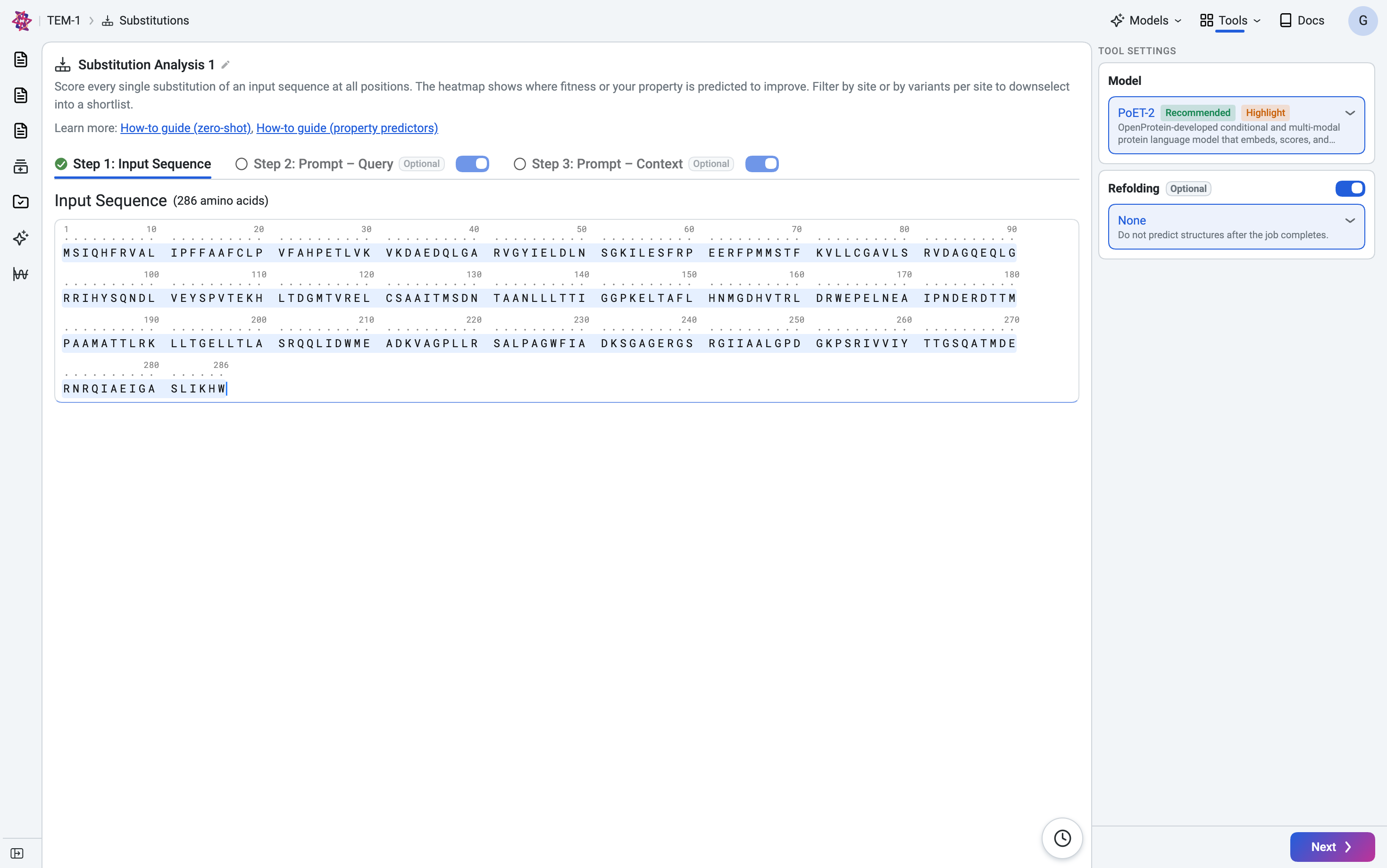
The tool opens with an input field for your sequence and PoET-2 selected as the default model.
Step 2: Enter the sequence
Paste the TEM-1 sequence into the first field:
MSIQHFRVALIPFFAAFCLPVFAHPETLVKVKDAEDQLGARVGYIELDLNSGKILESFRPEERFPMMSTFKVLLCGAVLSRVDAGQEQLGRRIHYSQNDLVEYSPVTEKHLTDGMTVRELCSAAITMSDNTAANLLLTTIGGPKELTAFLHNMGDHVTRLDRWEPELNEAIPNDERDTTMPAAMATTLRKLLTGELLTLASRQQLIDWMEADKVAGPLLRSALPAGWFIADKSGAGERGSRGIIAALGPDGKPSRIVVIYTTGSQATMDERNRQIAEIGASLIKHWThe sequence appears in the field. This is the protein whose single substitutions PoET-2 will score.
Step 3: Select PoET-2 and set the prompt
- Choose PoET-2 as the model. It is recommended for most substitution analyses.
- Disable the Prompt Query.
- Set the context in Prompt Context. Input the TEM-1wild type sequence. Set the number of prompts to ensemble to 5.
- Leave the sampling method fields at their defaults.
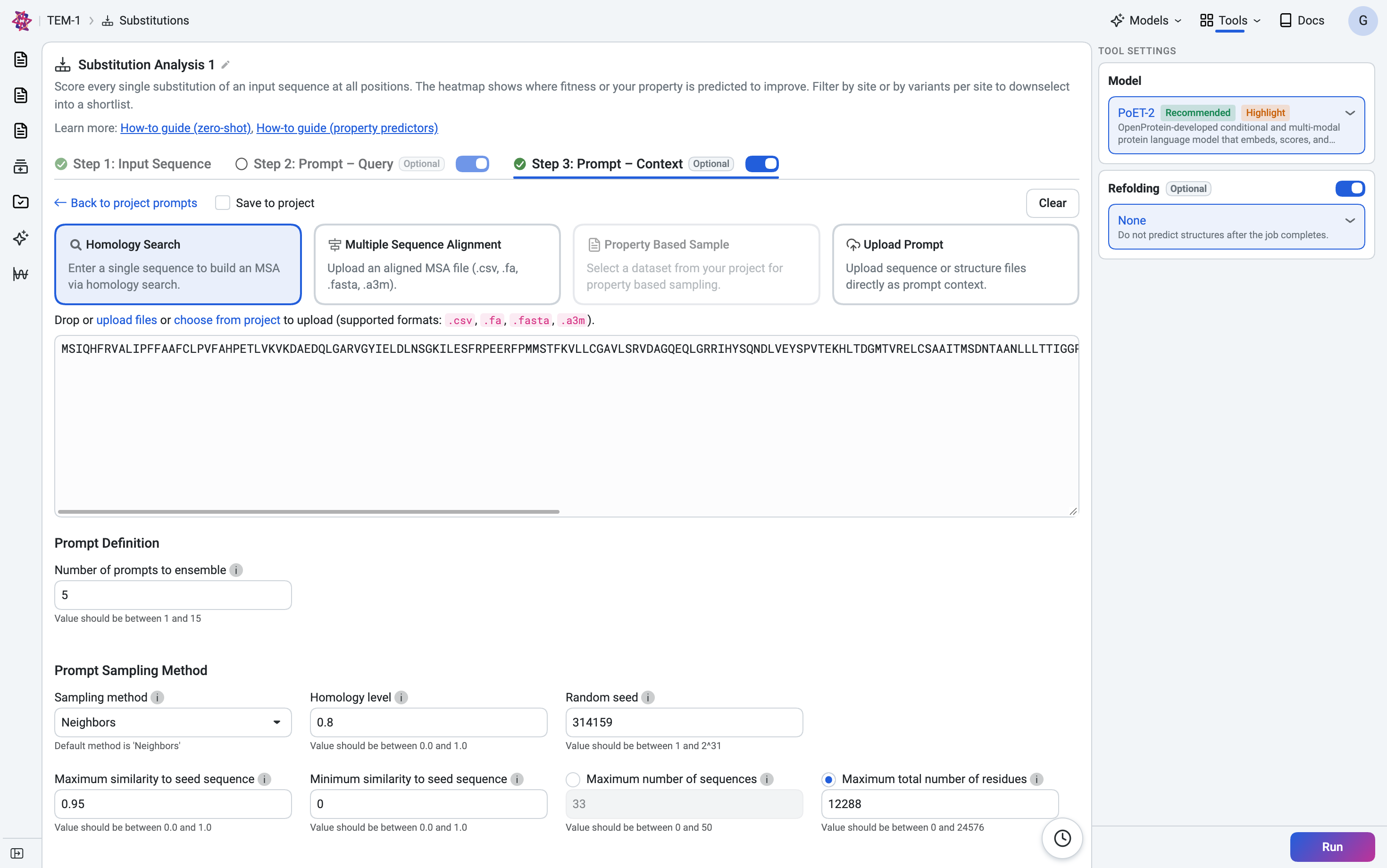
PoET-2 scores each variant in the context of this prompt, with the prompt providing information to PoET-2 about the evolutionary landscape around this protein. For more info, see prompts (/concepts/prompts/).
Step 4: Run the prediction
Click Run. The job can take a few minutes.
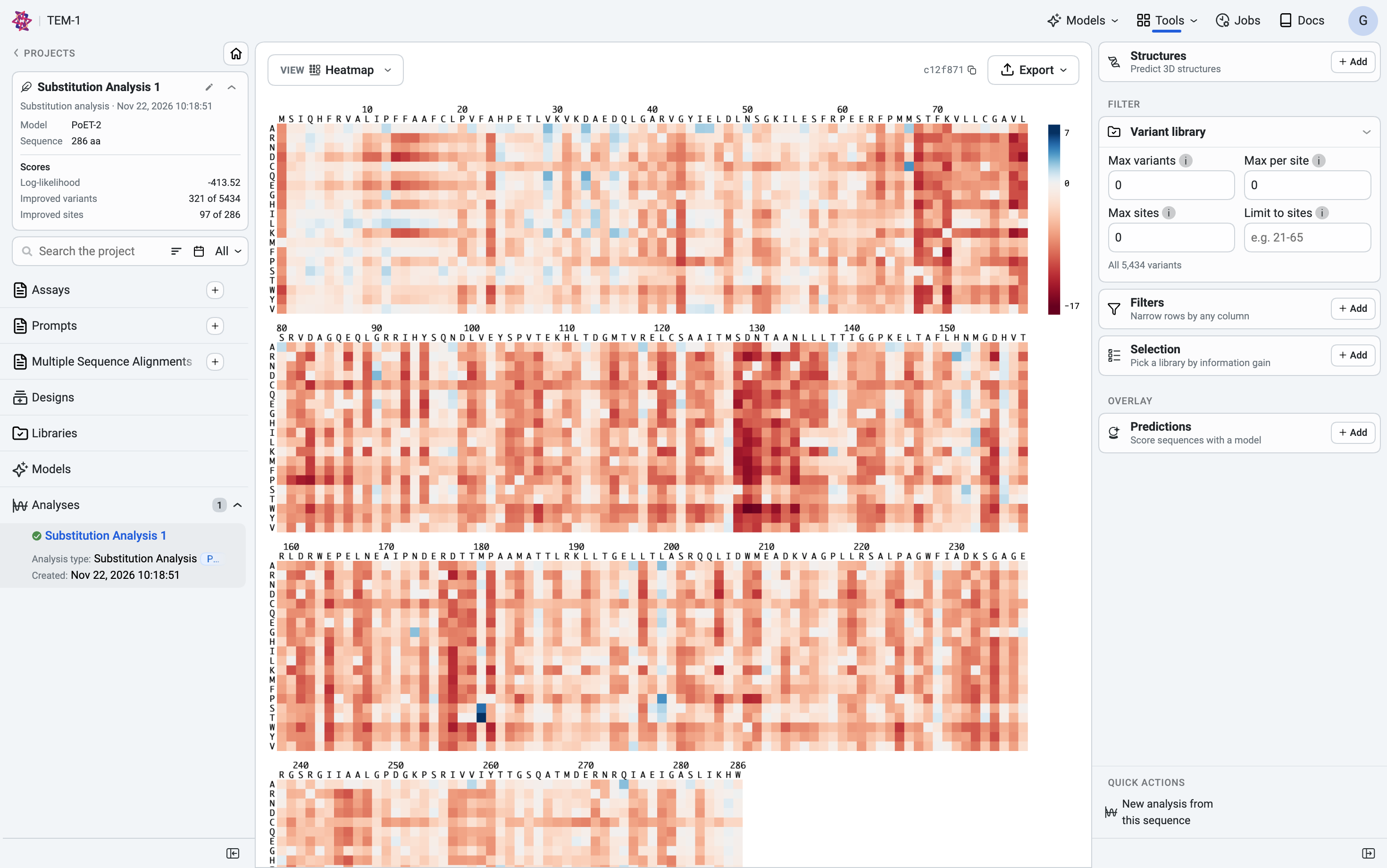
When it finishes, the results open with a heatmap of scores and, below it, tables of the highest-scoring variants and sites.
Step 5: Read the results
Open the Results tab. Each position in the heatmap represents a possible single-point mutation from the wild type to the amino acid corresponding to the row of the heatmap, and is associated with a relative log-likelihood score. Hover over a site to see the score. The higher, or less negative, the score, the fitter that variant is compared with the input sequence.
In the heatmap, blue marks improved fitness (a positive score), red marks reduced fitness (a negative score), and a white site indicates a neutral substitution that does not strongly impact fitness.
The tables below the heatmap list the top variants and sites. Click Export to download them. The Input tab shows the parameters used for the run.
Step 6: Narrow the list with a filter
Substitution analysis will yield 19 * (sequence length) possible protein sequences. We can narrow down this large list with filters to make it more tractable.
Set Max Variants to 50. The table drops to 50 variants based on the highest log likelihood scores which indicates fitness to your protein family, and the matching sites stay highlighted in the heatmap.
Other filters let you cap variants per site, cap the number of sites, or limit the analysis to specific site numbers (for example 1; 3; 5; 7, or a range like 21 - 65).
What we've done
In this tutorial, we scored every single-substitution variant of TEM-1 with PoET-2, read the scores as a heatmap and tables, and narrowed them with a filter. That is the full single-sequence workflow, with no model training required.
Next steps
- Score higher order mutants with the Batch Analysis.
- To view the 3D structure of a variant, use the Structure Prediction tool.